About Me
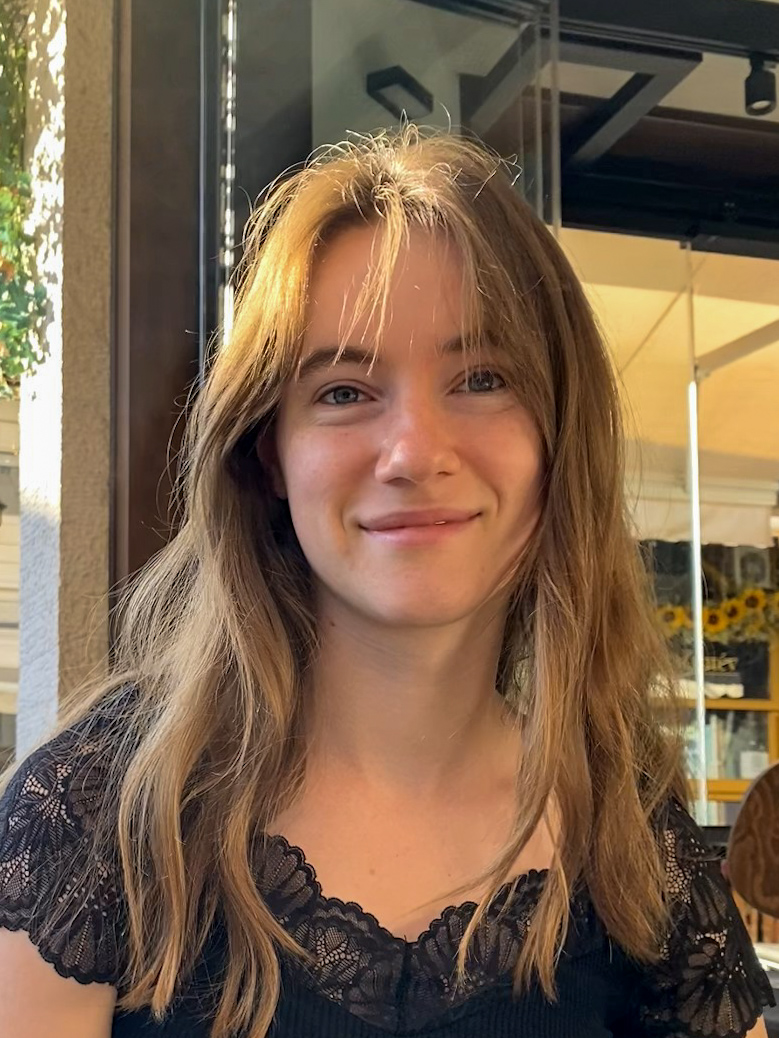
Hi! My name is Maurien, and I'm located in South Holland, The Netherlands. I’m a Data Scientist with a passion for turning complex data into meaningful insights, currently working at a R&D-company while pursuing my Master’s in Astronomy and Data Science. Beyond my technical work, I enjoy contributing to the academic community as an elected member of the Faculty Council and participating in politics as a policy assistant for a local municipal political party.
I’m curious by nature, enjoy working at the intersection of science, technology, and society, and have a background that includes mentoring, committee work, and hands-on experience in both research and community organizations.
This website is a small side project where I’m learning to build and design websites while sharing a bit about myself and the things I love along the way.
Curriculum Vitae
Experience
- 2025–Present: Data Scientist at R&D-company
- 2025–Present: Elected member of the Faculty Council for Faculty of Science and Mathematics
- 2022–Present: Policy Assistant for local political party (municipal level)
- 2024–2025: Internship at R&D-Company
- 2022–2024: Hospitality Staff at various restaurants
- 2021–2023: Mentor for first-year students
- 2016–2020: Greenhouse Assistant
Education
- 2019-2020: Propaedeutic Diploma in Physics
- 2017-2019: Pre-University Education (VWO)
- 2012-2017: Senior General Secondary Education (HAVO)
Licenses and Certificates
- 2025: Adobe Premiere Pro Advanced (Competence Factory)
- 2023: Adobe Premiere Pro Base (Competence Factory)
- 2022: Microsoft Certified: Azure Fundamentals (Microsoft)
- 2022: Seminar on Computational Physics (Leiden Institute of Physics)
Volunteering
- 2026: Marine Conservation Volunteering project >
- 2020–2023: Committee Work at Study Association
- 2021–2023: Committee Work at a Youth Political Movement
- 2021–2022: Board Member of Study Sub-Association
Skills
Projects
Educational
Astronomy Bachelor Project: Searching for hypervelocity star candidates in Gaia DR3 (2023)
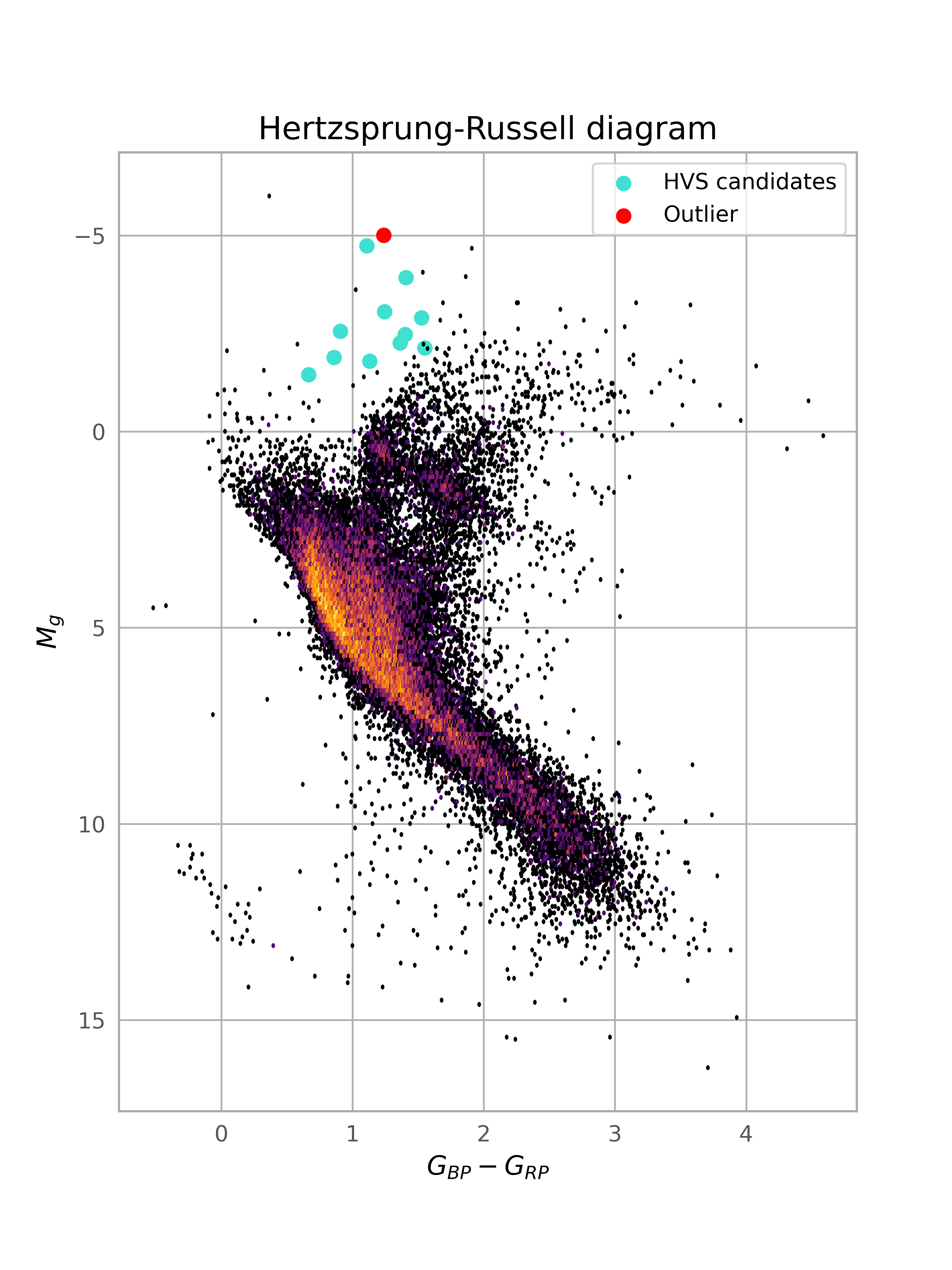
This research searched for hypervelocity stars (HVSs) in Gaia data release 3. A hypervelocity star is a star moving at such a high speed that the star is unbound from its galaxy of origin. These stars are thought to have been kicked out of their orbits by gravitational interactions with other objects, such as other stars or black holes. Finding HVSs may therefore give insight into the properties of massive black holes.
We focused on HVSs that originated in the galactic centre of our Milky Way and have been ejected according to the Hills mechanism. We searched for HVS in a region where we expect the highest density of them. This region we defined ourselves based on the results of the spatial distribution for HVS simulations from Generozov et al. (2022) and the found clumped HVS candidates from Brown et al. (2014). We found a way of searching within that region for HVSs, not knowing the radial velocities and distances of the stars. A number of 12,377,535 HVS candidates have been found in total. Whereof 11 HVS candidates would have been ejected from the GC around the same time as the clumped stars from Brown et al. (2014).
Astronomy First Master Project: Real time classification with DISTURB (2024)
Solar Radio Bursts are the associated radio emissions of solar flares, often characterized by a high intensity and observed as complex patterns in dynamic spectral images. Based on those patterns, five spectral types can be distinguished; spectral types I to V. Each spectral type has its own emission mechanism which relates them to space weather on Earth, making the task of real-time detection and classification valuable. Type-II's are in particular interesting due to their greatly varying time structures and relatively rare occurrence, making this type a challenge to accurately classify.
With data from DISTURB, located at the site of the WRST, Dwingeloo, The Netherlands, 73 type-II's were identified from October 2023 to March 2023. Along the type-II's 685 individual type-III's, 337 type-III clusters and 29 type-V's were identified and used to train a YOLO model.
The YOLO series popped up in papers as "state of the art" algorithm. Its latest version (from late 2023), version 8, didn't disappoint. Compared were the YOLO-v8 Nano, Small, Medium, and Large model versions. Found was the Nano version to be the best for type-II's and good for type-III's and type-V's.
Trained is a final YOLO-v8 Nano model that accurately classifies type-II's, individual type-III's and type-III clusters with MAP-scores at the IoU threshold of 0.5 of 0.890, 0.890 and 0.837 respectively and type-V's of 0.304. The optimal precision scores of the classes are 0.94, 0.90, 0.88 and 0.25 for the classes. With the final model, type-II's can be detected with high accuracy within minutes after the start of the burst. Making real life detection and classification possible.

Astronomy Second Master Project: PRISMA hyperspectral data for terrain assessments (2025)
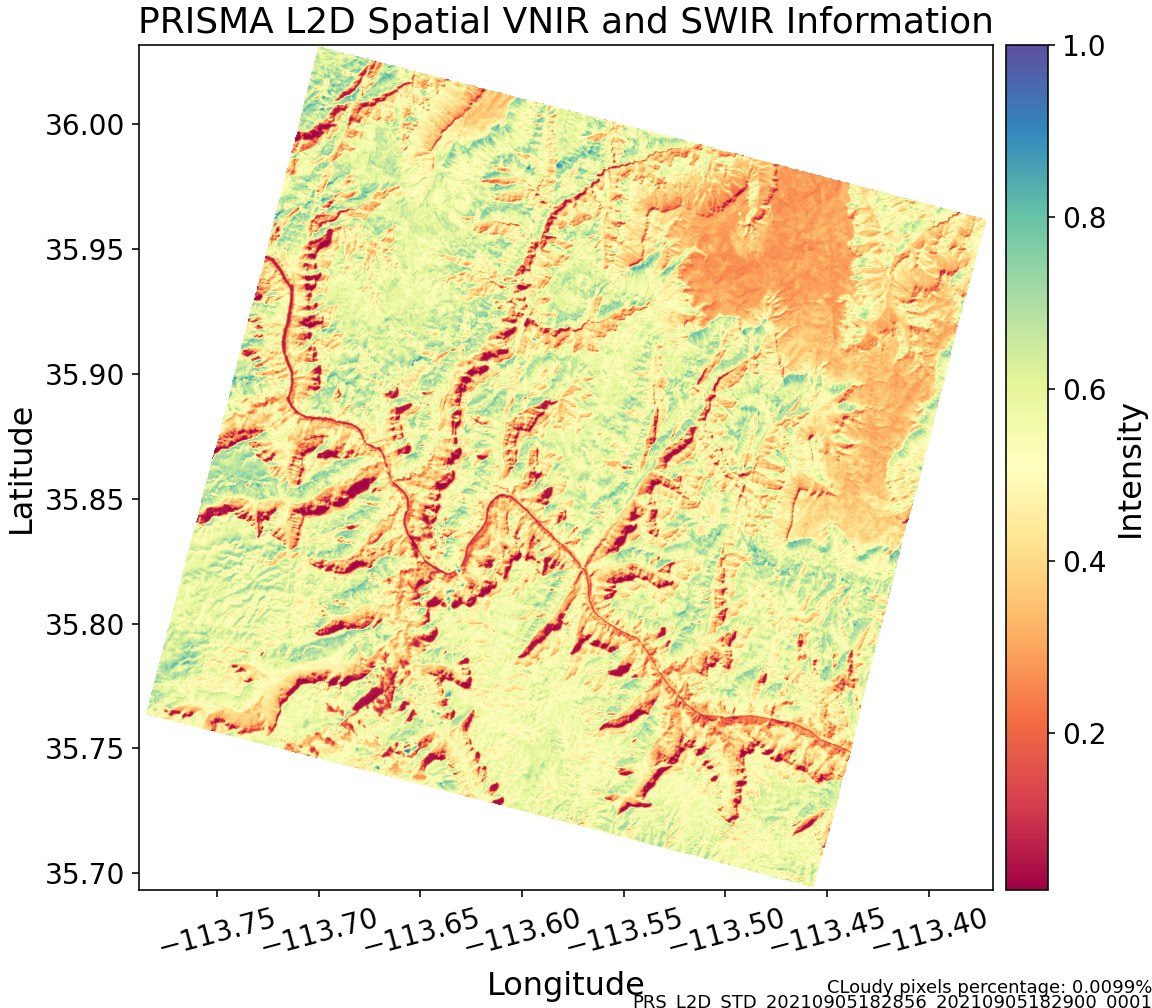
Terrain assessment is gaining importance in military applications, with soil classification serving as a critical foundation. PRISMA hyperspectral L2D images, combined with soil information from the SSURGO database, were used to train various machine learning algorithms to differentiate between soil types. The results indicate the effectiveness of hyperspectral data from the PRISMA satellite for training models to classify soil types. However, achieving generalizability remains challenging due to the fine variations among different labels and widely variable hyperspectral signatures across the images.
The model architecture best suited for the complex task of training on hyperspectral images is found to be a 1D-CNN, as it effectively identifies underlying structures in the data. In contrast, tree-based models, although able to train on the data effectively, did not appear to capture any meaningful structure. A different model, the D2-BERT model, was also tested. While it performed approximately the same as the 1D-CNN, its architecture was found to be unnecessary complex for the task. Additionally, several improvement suggestions are proposed to enhance model generalizability.
Personal side quests
Marine Conservation Volunteering Project (2026)
Coming soon...